
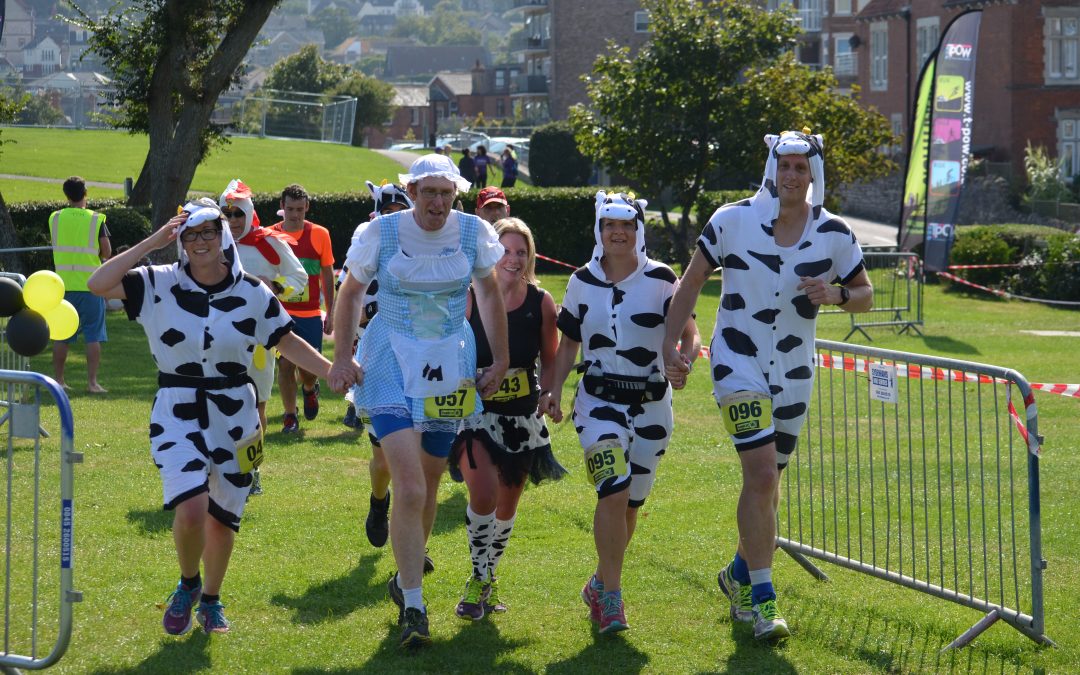
The Purbeck Marathon represents a fundamentally different challenge compared to traditional city road races. Flat, paved events like the London Marathon or the Manchester Marathon are engineered for speed. They offer smooth asphalt surfaces, predictable footing, and minimal elevation changes—London features just 127 metres of gentle gradient. In contrast, the Purbeck Marathon trades city landmarks for the wild, rugged terrain of the Jurassic Coast and the South West Coast Path.
The primary difference lies in the topography. While road runners focus entirely on locking into a consistent, machine-like mile pace, Purbeck runners must adapt as they go. The course serves up 1,032 metres (over 3,000 feet) of total elevation gain, including four climbs that require most athletes to shift from a running stride to an efficient power-hike. Furthermore, tarmac is replaced by coastal path, trail and rolling countryside. These elements require different lateral stability and mental focus to prevent slips or rolled ankles.
TRAIL VS. ROAD MARATHON COMPARISON
Elevation: 1,032m
Terrain: Trail
Focus: Power & Agility
Strategy: Self-Funded
VS.
Elevation: 127m
Terrain: Smooth Road
Focus: Steady Pace
Strategy: Aid Stations
Because of these demands, conquering the Purbeck ridges is exceptional preparation for world-class mountain events like the Ultra-Trail du Mont-Blanc (UTMB) and IronMan world series. While UTMB races take place on much longer alpine paths, the underlying physiological and technical skills required are similar. Purbeck provides a perfect training environment to master power-hiking mechanics, protecting your lower back and calves from premature fatigue.
The descents also mimic alpine racing. They train your quadriceps to handle heavy eccentric loading, building the cellular resilience needed to survive long mountain downhills without your legs “blowing up.” Finally, the self-sufficient nature of the coastal path helps you to practice ultra race skills: managing your own hydration vest, fueling, and adapting to unpredictable coastal weather.
This 16-week training plan is specifically structured to prepare your body for these rugged trail demands. It transitions from building a solid aerobic base to trail-specific strength and peak endurance using a 3-weeks-hard, 1-week-easy periodisation cycle to ensure adequate recovery.
Training Plan Overview
- Hill Strength: Focus entirely on effort, not pace, during hill repeats.
- Time on Feet: Long runs should ideally be done on trails to condition your joints.
- Rest: Essential for muscle repair, tendon adaptation, and injury prevention.
The 16-Week Weekly Schedule
| Week | Mon |
Tue (Intervals/ |
Wed |
Thu (Tempo/ |
Fri | Sat (Easy) | Sun (Long Run) | Phase Focus |
| 1 | Rest | 4 miles (Flat, easy) | Rest | 4 miles (Steady) | Rest | 3 miles (Easy) | 6 miles (Road/Trail) | Phase 1: Base |
| 2 | Rest | 4 miles + 4x 30s hill strides |
Rest | 5 miles (Steady) | Rest | 3 miles (Easy) | 8 miles (Trail) | Phase 1: Base |
| 3 | Rest | 5 miles + 5x 30s hill strides |
Rest | 5 miles (Steady) | Rest | 4 miles (Easy) | 10 miles (Trail) | Phase 1: Base |
| 4 | Rest | 3 miles (Easy) | Rest | 4 miles (Easy) | Rest | Rest | 6 miles (Flat trail) | Phase 1: Recovery |
| 5 | Rest | 5 miles (Inc. 4x 1-min hill repeats) |
Rest | 5 miles (Trail tempo) | Rest | 4 miles (Easy) | 11 miles (Hilly trail) | Phase 2: Strength |
| 6 | Rest | 5 miles (Inc. 5x 1-min hill repeats) |
Rest | 6 miles (Trail tempo) | Rest | 4 miles (Easy) | 13 miles (Hilly trail) | Phase 2: Strength |
| 7 | Rest | 6 miles (Inc. 6x 1-min hill repeats) |
Rest | 6 miles (Trail tempo) | Rest | 5 miles (Easy) | 15 miles (Hilly trail) | Phase 2: Strength |
| 8 | Rest | 4 miles (Easy) | Rest | 4 miles (Easy) | Rest | Rest | 8 miles (Flat trail) | Phase 2: Recovery |
| 9 | Rest | 6 miles (Inc. 4x 2-min hill repeats) |
Rest | 7 miles (Trail pace) | Rest | 5 miles (Easy) | 16 miles (2 major climbs) | Phase 3: Peak |
| 10 | Rest | 6 miles (Inc. 5x 2-min hill repeats) |
Rest | 7 miles (Trail pace) | Rest | 5 miles (Easy) | 18 miles (3 major climbs) | Phase 3: Peak |
| 11 | Rest | 7 miles (Inc. 6x 2-min hill repeats) |
Rest | 8 miles (Trail pace) | Rest | 6 miles (Easy) | 20 miles (4 major climbs) | Phase 3: Peak |
| 12 | Rest | 4 miles (Easy) | Rest | 5 miles (Easy) | Rest | Rest | 10 miles (Flat trail) | Phase 3: Recovery |
| 13 | Rest | 5 miles (Inc. 4x 1-min hill repeats) |
Rest | 6 miles (Steady) | Rest | 4 miles (Easy) | 14 miles (Hilly trail) | Phase 4: Taper |
| 14 | Rest | 4 miles (Steady) | Rest | 5 miles (Easy) | Rest | 3 miles (Easy) | 10 miles (Trail) | Phase 4: Taper |
| 15 | Rest | 3 miles (Easy) | Rest | 4 miles (Easy) | Rest | Rest | 5 miles (Flat trail) | Phase 4: Taper |
| 16 | Rest | 2 miles (Easy shakeout) | Rest | Rest | Rest | Rest | RACE DAY (26.2 Miles) | The Purbeck Marathon |
Key Workouts Explained
- Hill Repeats: Find a gradient of 4–8%. Run up at a hard effort (8/10), focusing on high knees and driving your arms. Walk or jog slowly down for recovery.
- Trail Tempo: Run on a varied off-road route. Maintain an effort where you can only speak in short sentences, practicing efficient foot placement over roots, rocks, and mud.
- Sunday Long Runs: These are your most important sessions. Do not worry about your mile splits. Focus on keeping your heart rate low, walking the steepest gradients, and practicing your race-day hydration and nutrition strategy.