
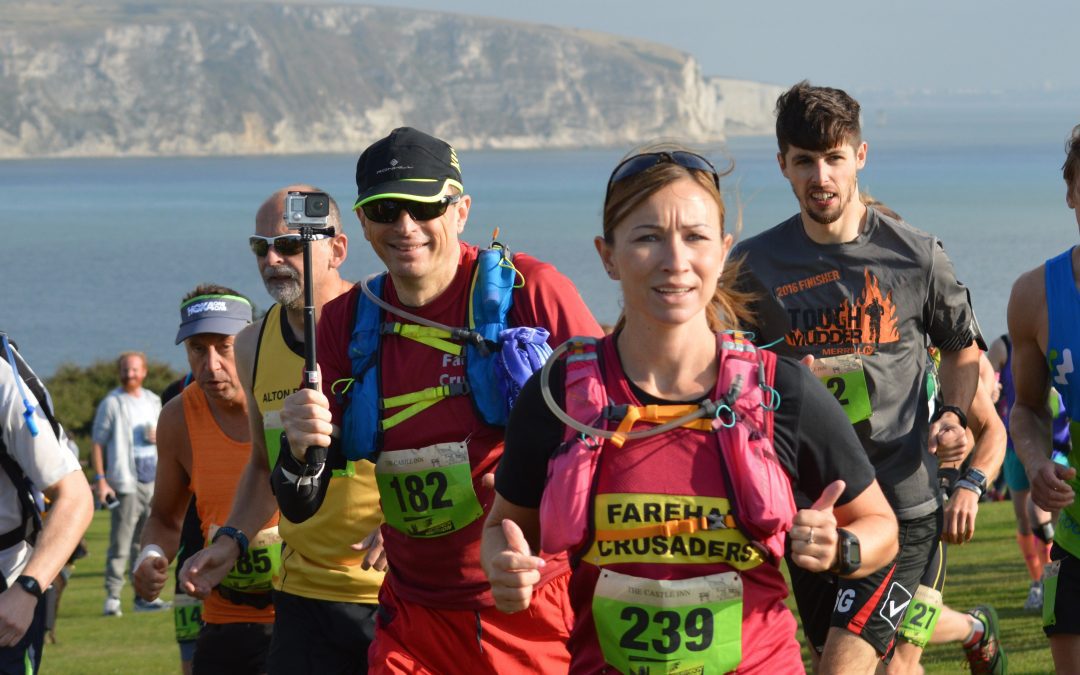
Training for a trail marathon takes around 12 to 16 weeks if you already have a solid running base. The biggest difference from road training is the work you put into hills, uneven ground and time on your feet, rather than chasing a fast flat pace. Get those three things right and a hilly course like the Purbeck Marathon becomes a challenge you can genuinely enjoy rather than survive.
If you have run on roads before and you are eyeing up your first proper trail marathon, this guide will walk you through what actually matters. No filler, no copied road plan with the word “trail” stuck on the front. Just the sessions, the structure and the mistakes to avoid.
Why Trail Marathon Training Is Different
That means trail training has to build more than just your engine. You need strength, balance and the kind of leg durability that only comes from running on the ground you will actually race on. A course like the Purbeck Marathon climbs 1,039 metres across 26.2 miles. You cannot prepare for that by running laps of a flat park.
The good news is that the fitness you build for trails is deeply satisfying. You finish training stronger, more capable and far more confident on your feet than road running alone will ever make you.
What Base Fitness You Need Before You Start
Be honest with yourself here. A trail marathon is a big undertaking and rushing into it is the fastest route to injury.
Before you begin a 12-week plan, you should ideally be:
- Running three or four times a week already
- Comfortable covering at least 15 to 20 miles a week
- Able to run for 60 to 90 minutes without stopping
If you are not there yet, spend a few weeks building up gently before you start the plan proper. Increase your weekly distance by no more than 10 percent at a time. There is no prize for arriving at week one already exhausted.
If you are coming straight from a road marathon background, you have the aerobic engine already. What you will need to add is hill strength and trail confidence, which we will come to.
The 12-Week Structure at a Glance
A good trail marathon plan moves through three phases.
Weeks 1 to 4 are the base phase. You build steady mileage, add your first hill sessions, and get your legs used to trail terrain. Keep most runs easy and conversational.
Weeks 5 to 9 are the build phase. This is where the real work happens. Your long runs get longer, your hill reps get tougher, and you start practising on ground similar to your race. Your longest run should fall in week 9 or 10.
Weeks 10 to 12 are the taper. You cut your mileage right back, keep a little intensity to stay sharp, and arrive at the start line fresh rather than flat.
The whole plan should fit around your life, not the other way round. If you need to move a session because of work or family, move it. Never run through illness or injury just because a plan tells you to.
The Four Sessions That Matter Most
The Long Run
Build your long run gradually until your longest effort reaches around three hours for the full marathon distance. Time on your feet matters more than exact mileage on a trail, because your pace will naturally be slower than on the road.
Hill Repeats
Hill reps build the exact muscles you will rely on when the course kicks upwards. They also teach your body to keep working when your legs are screaming.
The Easy Run
Easy runs are where a lot of runners go wrong. They run their easy days too hard and their hard days too easy. Keep the easy ones genuinely easy and you will recover better and improve faster.
Strength Work
Useful exercises include calf raises, lunges, step-ups, glute bridges and single-leg balance work. Fifteen to twenty minutes, twice a week, is plenty.
How to Train Specifically for Elevation
Use whatever hills you can find and run them repeatedly. If you have no hills at all, a treadmill on an incline works for building climbing strength. Stairs and multi-storey car parks have rescued many flatland trail runner.
Just as important is downhill running. Descending is where most runners lose time and pick up injuries. Practise running downhill on your training runs so your quads learn to absorb the impact. Lean slightly forward, keep your steps quick and light, and let gravity do some of the work rather than braking the whole way down.
Common Mistakes That Cause Injury Before Race Day
A few errors trip up first-time trail marathoners again and again.
- Increasing mileage too quickly. Your muscles, tendons and joints need time to adapt. Stick to the 10 percent rule.
- Skipping strength work. It feels optional until you are sidelined with a niggle six weeks before race day.
- Ignoring downhill practice. Sore quads on race day usually trace back to never training the descents.
- Running easy days too hard. This leaves you tired for the sessions that actually matter.
- Trying new kit on race day. Whatever you wear and eat on race day should have been tested in training first.
How to Taper in the Final Two Weeks
In the final two weeks, reduce your total mileage by around 40 to 50 percent. Keep a couple of short, sharp efforts in to stay sharp, but cut the long, draining sessions. Sleep well, eat well and trust your training.
One week out, do a dress rehearsal run. Sixty minutes in your full race kit, at the time of day the race starts, eating and drinking exactly as you plan to on the day. This irons out any surprises before they matter.
Frequently Asked Questions
How long should I train for a trail marathon?
Can I train for a trail marathon on flat ground?
How many days a week should I run?
Do I need to run the full marathon distance in training?
Ready to Put Your Training to the Test
The Purbeck Marathon on 20 September 2026 is one of the most rewarding trail challenges in the South of England. With 26.2 miles of Jurassic Coast running through Corfe Castle, Tyneham and the Purbeck Hills, it is the perfect goal to train towards.
Register for the Purbeck Marathon and give your training a finish line worth chasing. Prefer a shorter challenge first? The Purbeck 16 covers 16 miles of the same stunning route.