
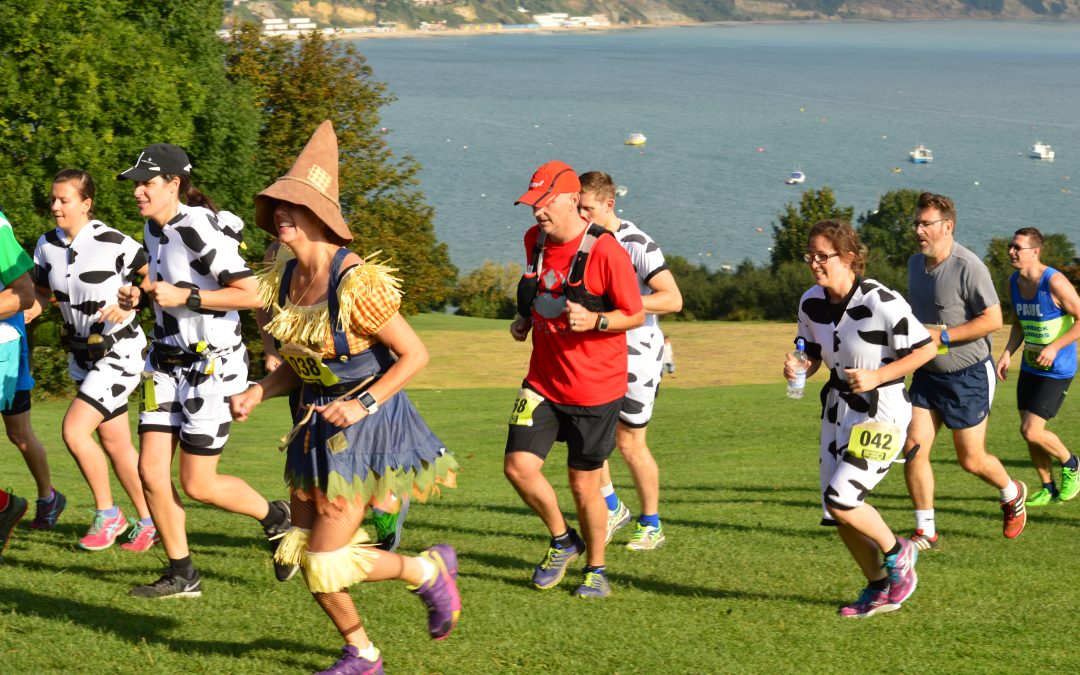
If you are thinking about entering, or you have already signed up and want to know what is coming, here is the route in full.
The First Mile: Leaving Swanage
The South West Coast Path here rises and falls sharply as it follows the cliff tops. The climbs are steep and the descents demand concentration. The sea stretches out to the horizon on one side, and the path demands every bit of your focus on the other.
These are the miles you will remember. They are hard, there is no pretending otherwise, but the reward is some of the finest coastal scenery in the country. World Heritage status was given to this coastline in 2001, and running it on race day is a privilege that few events can match.
Inland to Worth Matavers and Kinston
At Seacombe, the route turns inland an upwards. It’s the first big hill climb, though not the biggest, and leads you to the first water station in Worth Matravers. You then follow a road section that ends up being little more than a track and it winds gently down to hill bottom where you begin the next big climb. Still not the biggest.
At the top of the climb you enter the 12th century chapelry of Kingston.You turn left by the church that now stands on the site of the original chapel and this is where the Purbeck 16 runners split from the marathon route and head for Corfe.
Marathon runners however continue on a route past the Encombe estate and on to Swyre Head with magnificent views along the coast to Portland. Swyre Head is the highest point in the route at 650ft and it’s downhill from there, for a while.
Corfe Castle: Running Through History
To get to Corfe you have a steep descent into Corfe giving you fantastic views of the castle before you run beneath it. Few races anywhere give you a view like this, and even tired legs tend to lift a little as the castle comes into sight. Take a second to look up. You are running through nearly a thousand years of English history. And to top it off after you run through Corfe itself, you cross over the vintage railway where you may see one of the trains pass right before your eyes.
Of course having run down such a steep hill into Corfe means that there is another climb out. This one is both steep and long. When you think you have gotten to the top, keep going as it will still be going up.As you climb you will be able to see Corfe behind you and out in front of you is Swanage. The finish line is in sight.
Ulwell and Old Harry’s Rocks
Where the Tough Climbs Are
The early exit from Swanage is the first test but the climb from Secombe to Worth Matravers is the first big hill. The climb from Hill Bottom up to Kingston is the second big climb but it is at least on a firm track.
The second half delivers the steepest and most sustained climbs. The climbs out of Steeple Leaze to the Isle Of Purbeck view Point, into and out of Corfe and out of Ulwell to Old Harry’s are the three main hills. They are a tough test in themselves but together they are a real challenge. They are good practice for any UTMB race – if you are into that.
By the time you reach these, you will have tired legs, which is exactly why hill training and downhill practice matter so much in your preparation.
Approach the climbs with patience. Shorten your stride, keep your effort steady, and walk the steepest pitches if you need to. There is no shame in walking a savage climb. Even experienced trail runners do it on courses like this.
What the Views Actually Look Like
You get the rolling green of the Purbeck Hills, dotted with grazing cattle and crossed by ancient field boundaries. You get the dramatic ruins of Corfe Castle rising above its village.You may get sight of the local vintage trains, and you get mile after mile of cliff-top coastline, with the English Channel glittering below and the chalk and limestone cliffs falling away to hidden coves and beaches.
It is, quite simply, England at its very best. Many runners say the scenery alone is worth the entry fee.
Tips for Running the Route Well
A few pointers will help you get the most out of the course.
- Respect the early climb. Do not burn your matches in the first few miles. The hardest sections come later.
- Save something for the Purbeck Hills. The views are spectacular but even the undulations in the ridge take it out of you.
- Practise downhills in training. The descents on the hills are steep and will trash unprepared quads.
- Carry your own fuel and water. Checkpoints are spaced out and some stretches are far from support.
- Look up. You are running one of the most beautiful courses in the country. Take it in.
Frequently Asked Questions
Where does the Purbeck Marathon route start?
How much climbing is on the Purbeck Marathon course?
Is the Purbeck Marathon route marked?
Can I run the route in training before the race?
Want to Run This Route?
The Jurassic Coast running route is waiting for you on 20 September 2026. From the climb out of Swanage to the cliff paths of the Dorset coast, to the Purbeck Hills and ruins of Corfe Castle, and the views of Old Harry’s, the Purbeck Marathon is a course you will never forget.
Enter the Purbeck Marathon 2026 and run one of the most beautiful trail routes in England. You can also explore the full race information including route maps and elevation details.